
SAFORYNACADEMY
Fake Crypto Exchanges: Why You Can't Withdraw Your Money and How to Avoid Scams
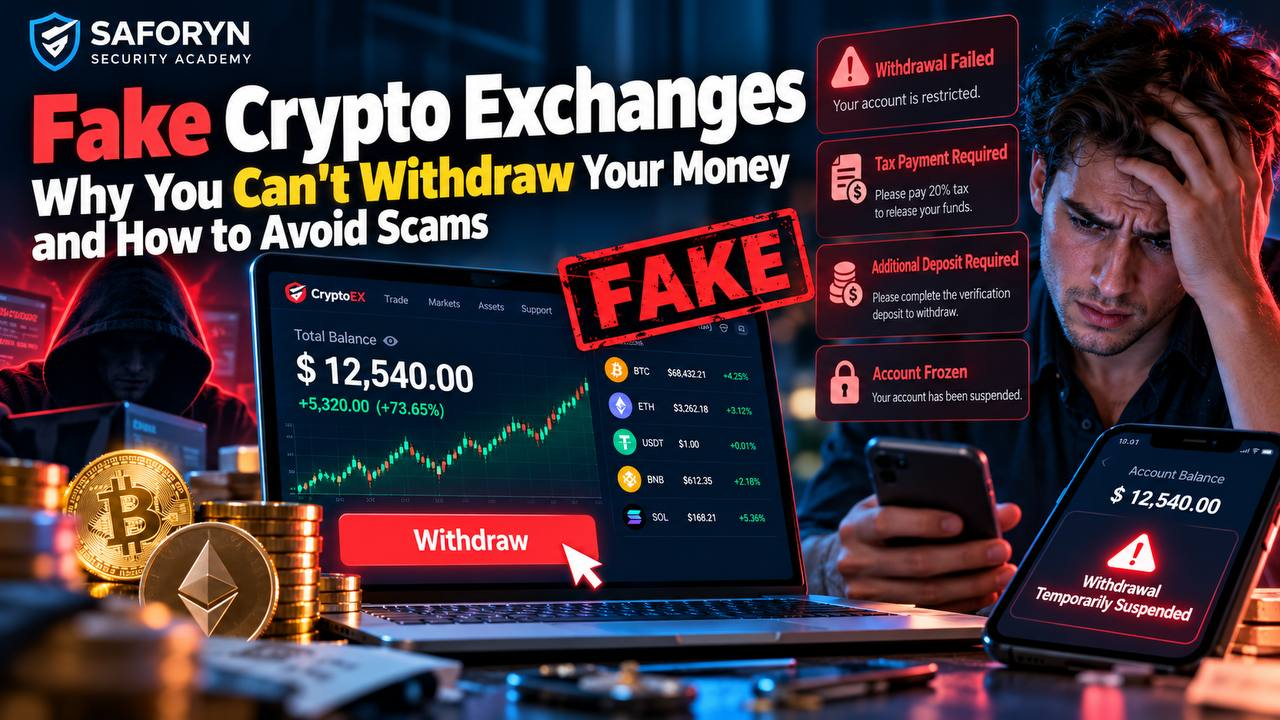
Your trading account shows thousands of dollars in profits. But when you try to withdraw, the platform suddenly demands a tax, verification fee, or additional deposit.
Imagine discovering a cryptocurrency trading platform that appears professional and trustworthy.
It displays live Bitcoin prices, trading charts, account balances, and customer support services.
You deposit $500 in USDT and begin trading.
Within a few days, your account shows a balance of $1,200.
Everything looks legitimate until you request a withdrawal.
Suddenly, the platform tells you that your account is restricted and that you must deposit another $300 to release your funds.
After paying, another problem appears. You are asked to pay taxes, upgrade your account, or complete additional verification.
Your money remains inaccessible.
This is a common pattern in fake cryptocurrency exchange scams, where criminals create fraudulent trading platforms to collect deposits and prevent victims from withdrawing their funds.
In this SAFORYN Security Academy guide, you'll learn how fake exchanges operate, how withdrawal scams work, and what steps you can take to protect your cryptocurrency.
1. What Is a Fake Cryptocurrency Exchange?
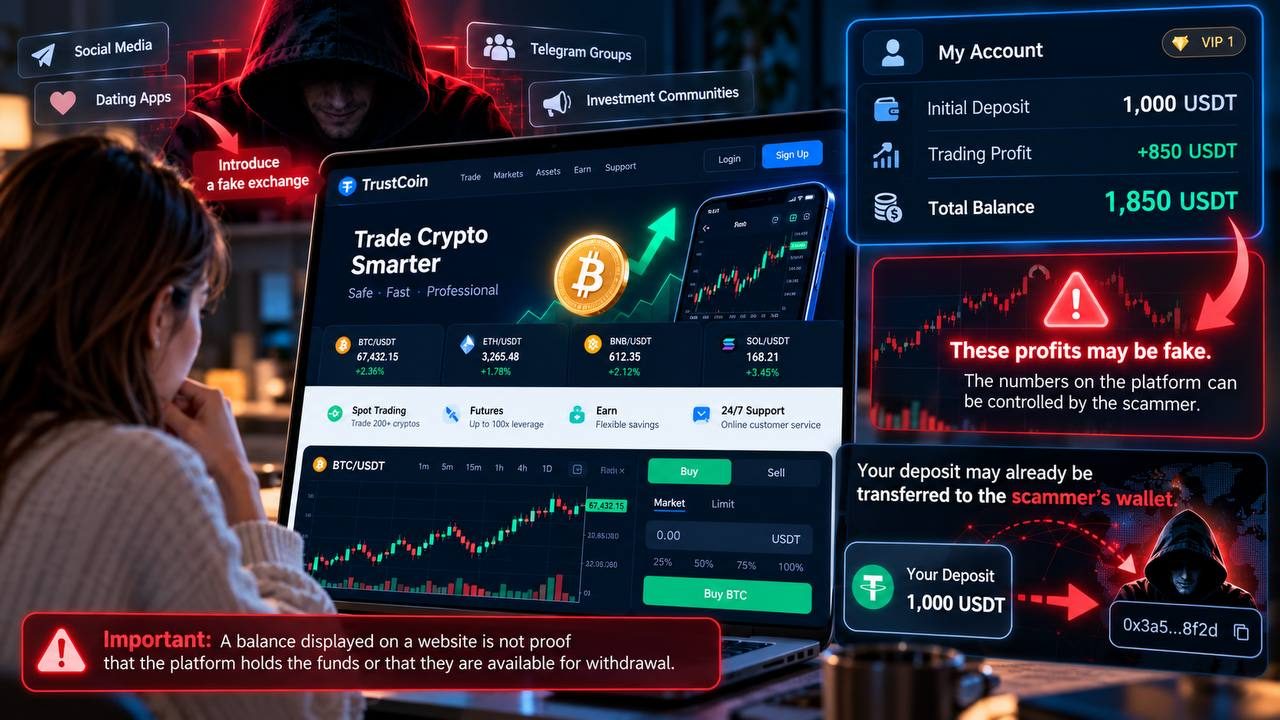
A fake cryptocurrency exchange is a fraudulent website or application designed to imitate a legitimate digital asset trading platform.
These platforms may display professional interfaces, market charts, trading pairs, account balances, and customer support features.
Some imitate established exchanges, while others invent entirely new brands.
Their primary goal is to persuade users to deposit cryptocurrency.
Unlike legitimate exchanges, fraudulent platforms may not execute real trades or hold assets in accounts controlled by users.
Instead, they may display fabricated trading activity and artificial profits.
For example, a victim deposits 1,000 USDT into a platform.
The dashboard later shows:
Initial Deposit: 1,000 USDT
Trading Profit: 850 USDT
Total Balance: 1,850 USDT
However, the displayed balance may simply be a number controlled by the scammer.
The cryptocurrency could already have been transferred to an attacker-controlled wallet.
Important: A balance displayed on a website is not proof that the platform holds the funds or that they are available for withdrawal.
2. How Fake Crypto Exchange Scams Work
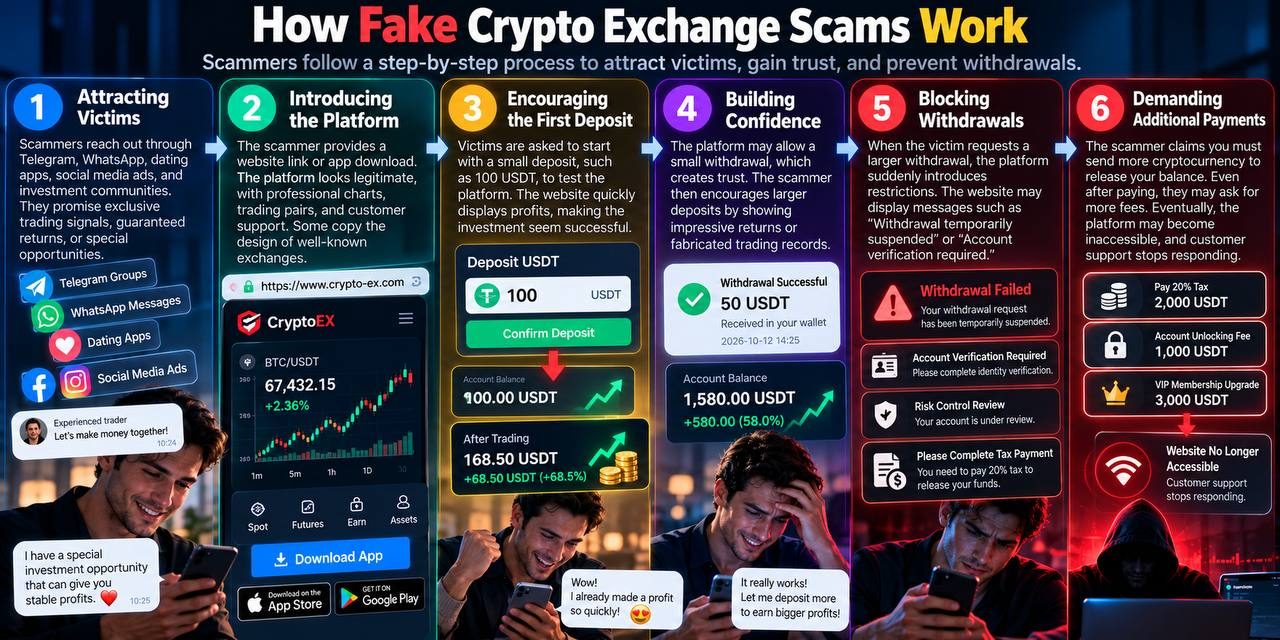
Fake exchange scams often follow six stages.
Stage 1 — Attracting Victims
Scammers promote fraudulent exchanges through Telegram groups, WhatsApp messages, dating applications, social media advertisements, and investment communities.
They may claim to offer exclusive trading signals, guaranteed returns, or special investment opportunities.
Some impersonate professional traders, financial analysts, or exchange employees.
Stage 2 — Introducing the Platform
The scammer provides a website link or application download.
The platform appears legitimate, displaying cryptocurrency prices, professional charts, and customer service options.
Some fake platforms copy the visual design of well-known exchanges.
Stage 3 — Encouraging the First Deposit
Victims are encouraged to start with a relatively small deposit.
For example, the scammer may suggest depositing 100 USDT to test the platform.
The website quickly displays trading profits, making the investment appear successful.
Stage 4 — Building Confidence
Some fraudulent platforms allow victims to withdraw a small amount.
This creates the impression that the exchange is reliable.
The scammer then encourages larger deposits by showing impressive returns or fabricated trading records.
Stage 5 — Blocking Withdrawals
When the victim requests a substantial withdrawal, the platform suddenly introduces restrictions.
The website may display messages such as:
"Withdrawal temporarily suspended."
"Account verification required."
"Risk control review in progress."
"Please complete your tax payment."
Stage 6 — Demanding Additional Payments
The scammer claims the victim must send more cryptocurrency to release the existing balance.
Even after paying, the victim may face additional demands.
Eventually, the platform may become inaccessible, and customer support stops responding.
3. Common Withdrawal Scam Tactics
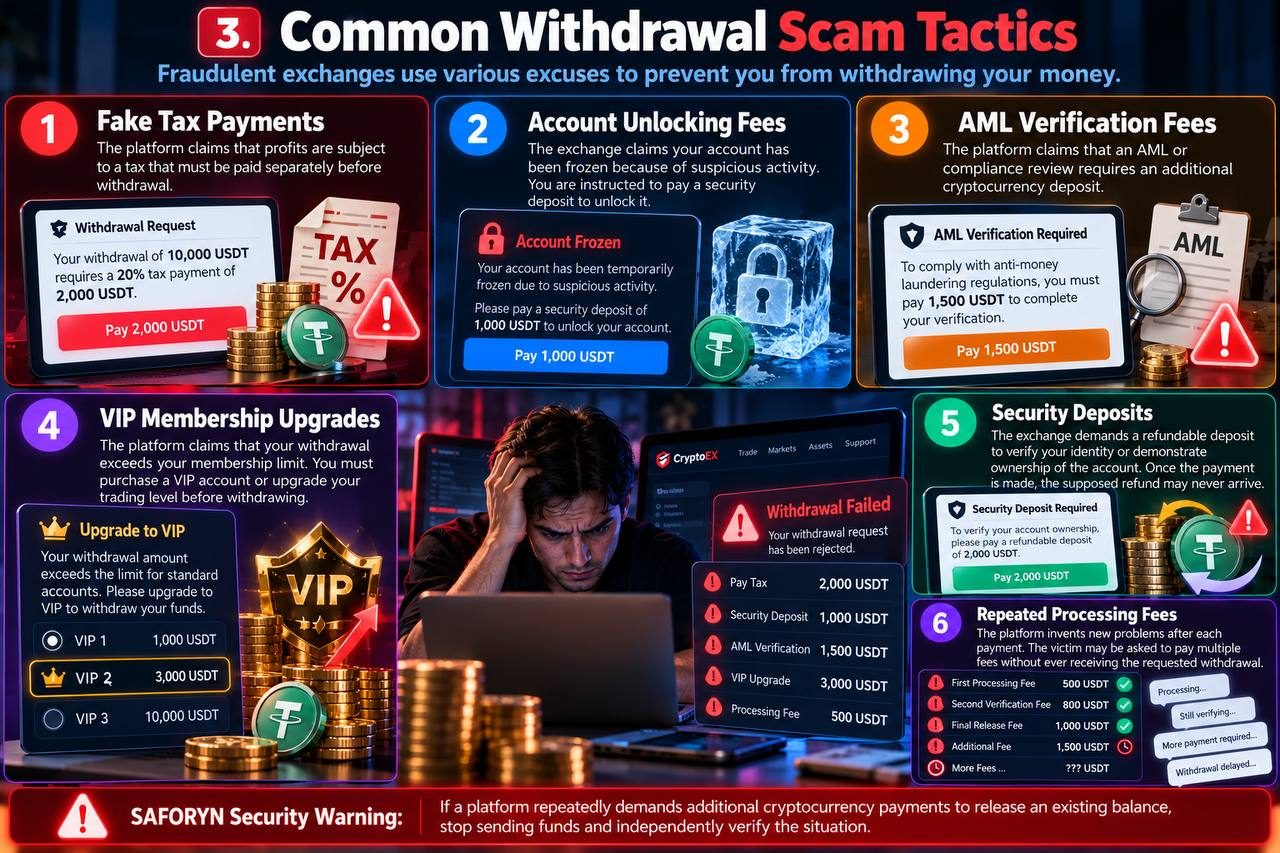
Fraudulent exchanges use several excuses to prevent victims from withdrawing their money.
Fake Tax Payments
The platform claims that profits are subject to a tax that must be paid separately before withdrawal.
For example:
"Your withdrawal of 10,000 USDT requires a 20% tax payment of 2,000 USDT."
The payment is sent to an address provided by the scammer.
Legitimate tax obligations do not make an unsolicited cryptocurrency payment address trustworthy.
Account Unlocking Fees
The exchange claims your account has been frozen because of suspicious activity.
You are instructed to pay a security deposit to unlock it.
Anti-Money-Laundering Verification Fees
The platform claims that an AML or compliance review requires an additional cryptocurrency deposit.
Legitimate exchanges may conduct compliance checks, but an unexplained payment to an unfamiliar wallet is a serious warning sign.
VIP Membership Upgrades
The platform claims that your withdrawal exceeds your membership limit.
You must purchase a VIP account or upgrade your trading level before withdrawing.
Security Deposits
The exchange demands a refundable deposit to verify your identity or demonstrate ownership of the account.
Once the payment is made, the supposed refund may never arrive.
Repeated Processing Fees
The platform invents new problems after each payment.
The victim may be asked to pay multiple fees without ever receiving the requested withdrawal.
SAFORYN Security Warning: If a platform repeatedly demands additional cryptocurrency payments to release an existing balance, stop sending funds and independently verify the situation.
4. A Typical Fake Exchange Scam Conversation
Consider this fictional example.
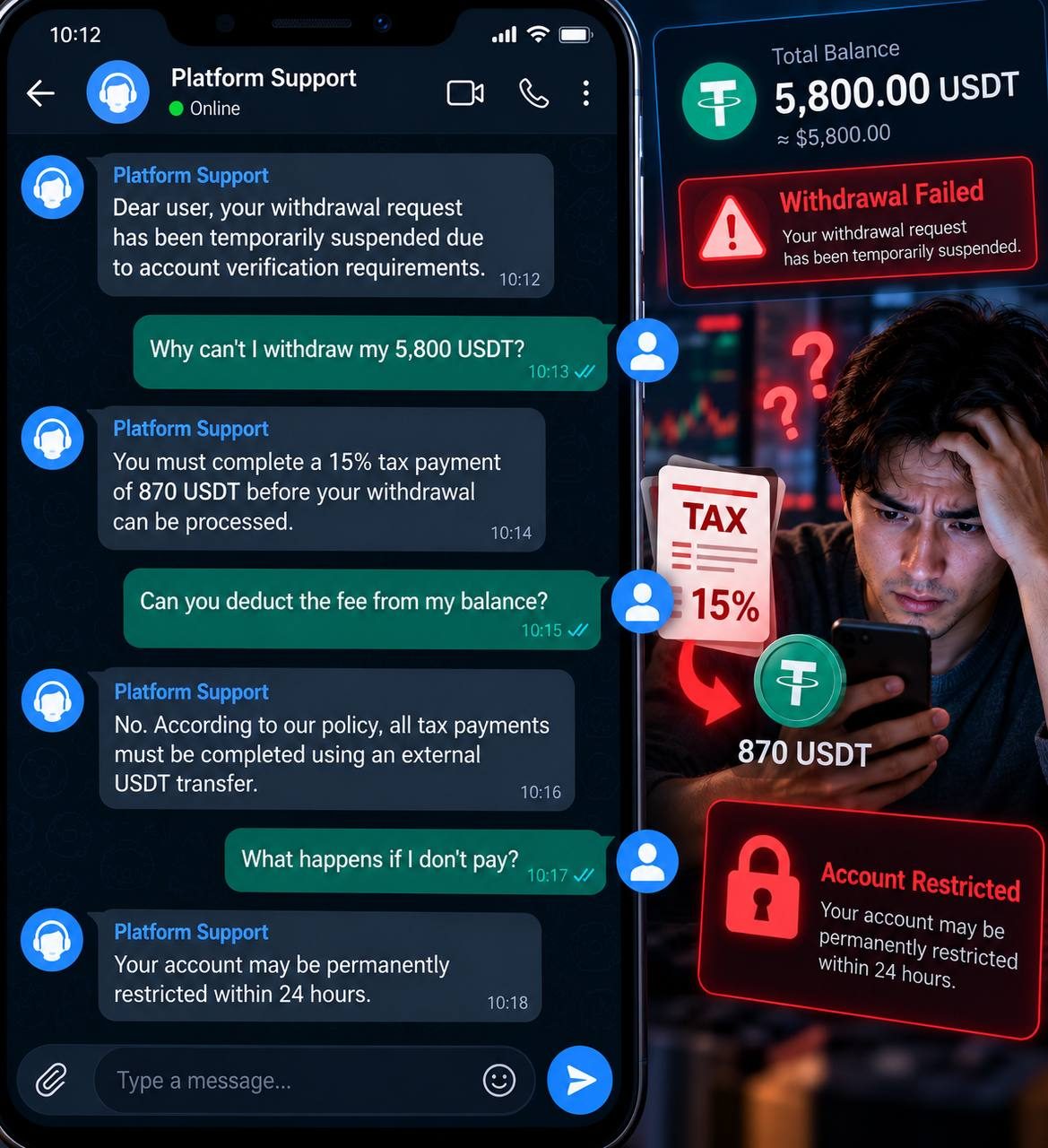
A cryptocurrency user discovers a trading platform through a Telegram investment group.
After depositing 2,000 USDT, the website displays a balance of 5,800 USDT.
The user attempts to withdraw the funds.
The victim pays the requested amount.
However, the platform then demands an additional 500 USDT security deposit.
At this point, the victim realizes that the withdrawal process may be fraudulent.
The displayed profits were never independently verified, and the platform continues requesting additional deposits.
This is a fictional educational scenario, not a verified real-world case.
5. Eight Warning Signs of a Fake Crypto Exchange
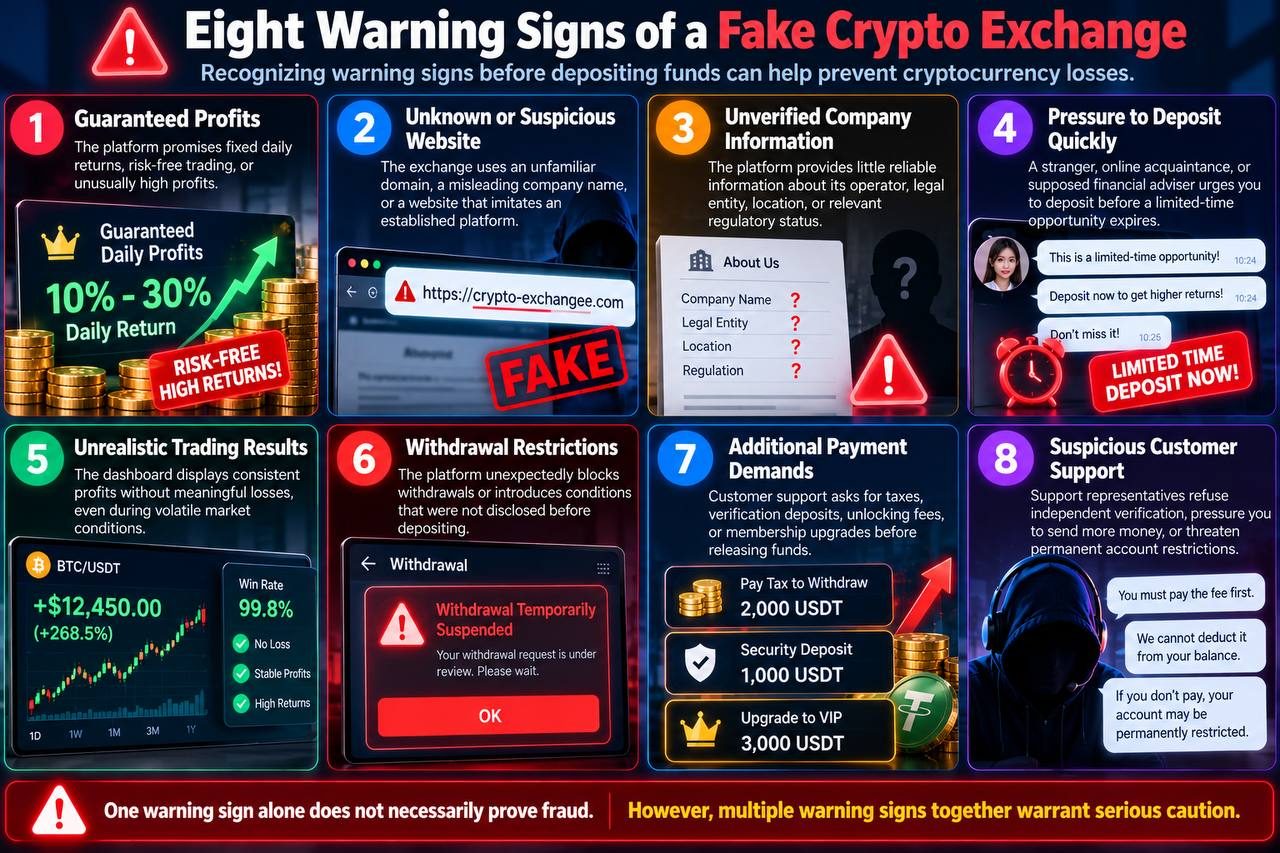
Recognizing warning signs before depositing funds can help prevent cryptocurrency losses.
1. Guaranteed Profits
The platform promises fixed daily returns, risk-free trading, or unusually high profits.
2. Unknown or Suspicious Website
The exchange uses an unfamiliar domain, a misleading company name, or a website that imitates an established platform.
3. Unverified Company Information
The platform provides little reliable information about its operator, legal entity, location, or relevant regulatory status.
4. Pressure to Deposit Quickly
A stranger, online acquaintance, or supposed financial adviser urges you to deposit before a limited-time opportunity expires.
5. Unrealistic Trading Results
The dashboard displays consistent profits without meaningful losses, even during volatile market conditions.
6. Withdrawal Restrictions
The platform unexpectedly blocks withdrawals or introduces conditions that were not disclosed before depositing.
7. Additional Payment Demands
Customer support asks for taxes, verification deposits, unlocking fees, or membership upgrades before releasing funds.
8. Suspicious Customer Support
Support representatives refuse independent verification, pressure you to send more money, or threaten permanent account restrictions.
One warning sign alone does not necessarily prove fraud. However, multiple warning signs together warrant serious caution.
6. How to Verify Whether a Crypto Exchange Is Legitimate
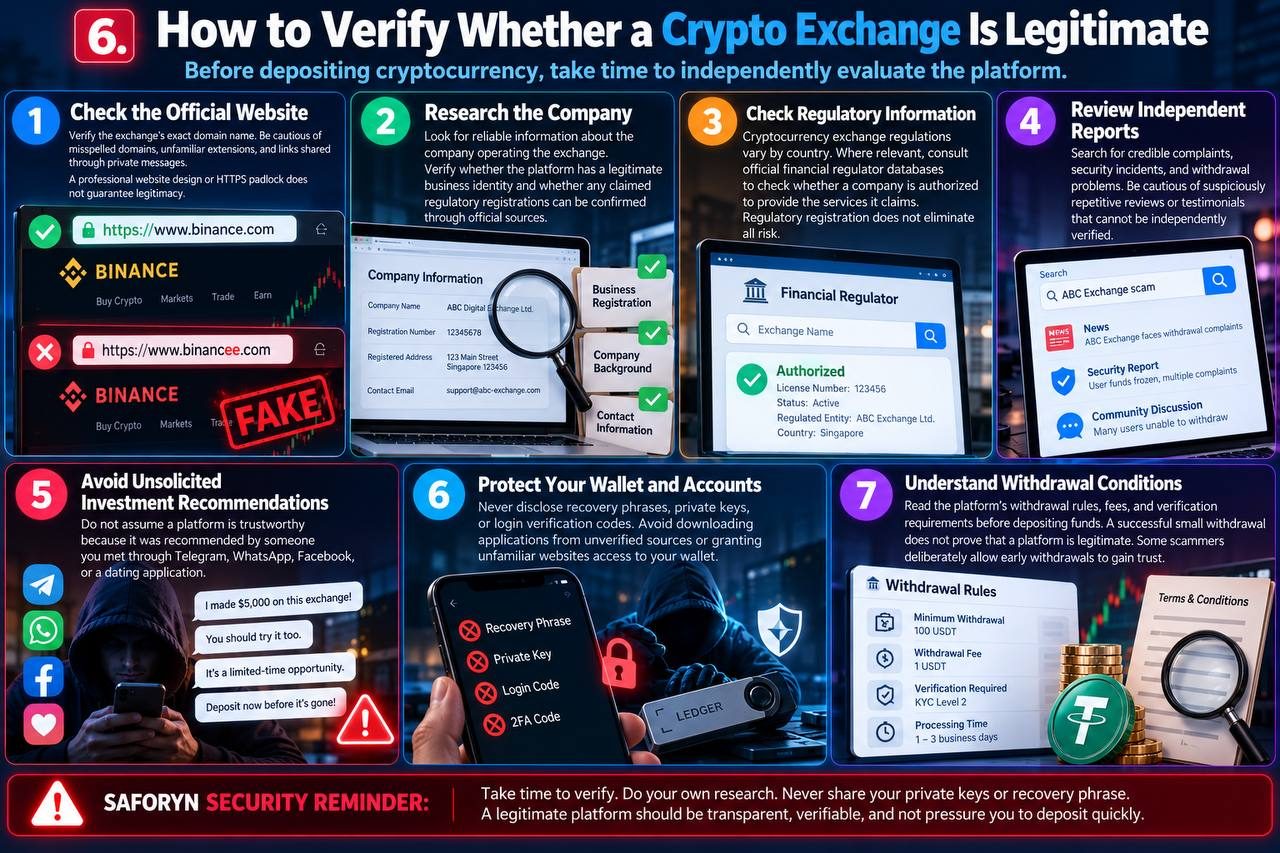
Before depositing cryptocurrency, take time to independently evaluate the platform.
Check the Official Website
Verify the exchange's exact domain name.
Be cautious of misspelled domains, unfamiliar extensions, and links shared through private messages.
A professional website design or HTTPS padlock does not guarantee legitimacy.
Research the Company
Look for reliable information about the company operating the exchange.
Verify whether the platform has a legitimate business identity and whether any claimed regulatory registrations can be confirmed through official sources.
Check Regulatory Information
Cryptocurrency exchange regulations vary by country.
Where relevant, consult official financial regulator databases to check whether a company is authorized to provide the services it claims.
Regulatory registration does not eliminate all risk.
Review Independent Reports
Search for credible complaints, security incidents, and withdrawal problems.
Be cautious of suspiciously repetitive reviews or testimonials that cannot be independently verified.
Avoid Unsolicited Investment Recommendations
Do not assume a platform is trustworthy because it was recommended by someone you met through Telegram, WhatsApp, Facebook, or a dating application.
Protect Your Wallet and Accounts
Never disclose recovery phrases, private keys, or login verification codes.
Avoid downloading applications from unverified sources or granting unfamiliar websites access to your wallet.
Understand Withdrawal Conditions
Read the platform's withdrawal rules, fees, and verification requirements before depositing funds.
A successful small withdrawal does not prove that a platform is legitimate. Some scammers deliberately allow early withdrawals to gain trust.
7. What Should You Do If Your Withdrawal Is Blocked?
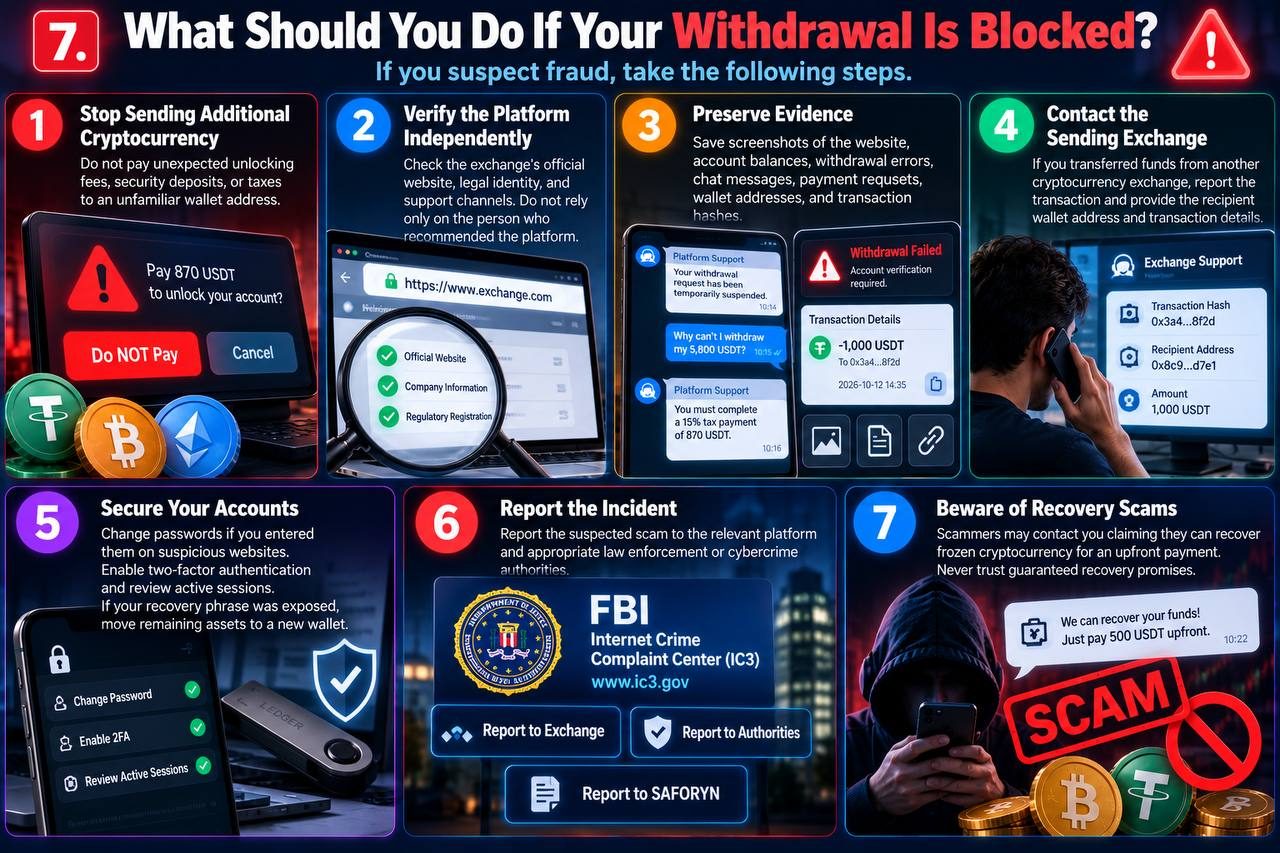
A blocked withdrawal does not always mean an exchange is fraudulent.
Legitimate platforms may temporarily restrict withdrawals for technical maintenance, compliance reviews, or security investigations.
However, repeated unexplained payment demands are a serious warning sign.
If you suspect fraud, take the following steps.
Step 1 — Stop Sending Additional Cryptocurrency
Do not pay unexpected unlocking fees, security deposits, or taxes to an unfamiliar wallet address.
Step 2 — Verify the Platform Independently
Check the exchange's official website, legal identity, and support channels.
Do not rely exclusively on information supplied by the person who recommended the platform.
Step 3 — Preserve Evidence
Save screenshots of the website, account balances, withdrawal errors, chat messages, payment requests, wallet addresses, and transaction hashes.
Step 4 — Contact the Sending Exchange
If you transferred funds from another cryptocurrency exchange, report the transaction and provide the recipient wallet address and transaction details.
The exchange may be able to assist with an investigation or flag relevant accounts, but recovery is not guaranteed.
Step 5 — Secure Your Accounts
Change passwords if you entered them on suspicious websites.
Enable two-factor authentication and review active sessions.
If your wallet recovery phrase was exposed, treat that wallet as compromised and safely move remaining assets to a newly created wallet.
Step 6 — Report the Incident
Report the suspected scam to the relevant platform and appropriate law enforcement or cybercrime authorities.
U.S. victims can report cryptocurrency fraud to the FBI's Internet Crime Complaint Center
Step 7 — Beware of Recovery Scams
Scammers may contact you claiming they can recover frozen cryptocurrency for an upfront payment.
Never trust guaranteed recovery promises.
8. Why Fake Exchange Scams Are So Dangerous
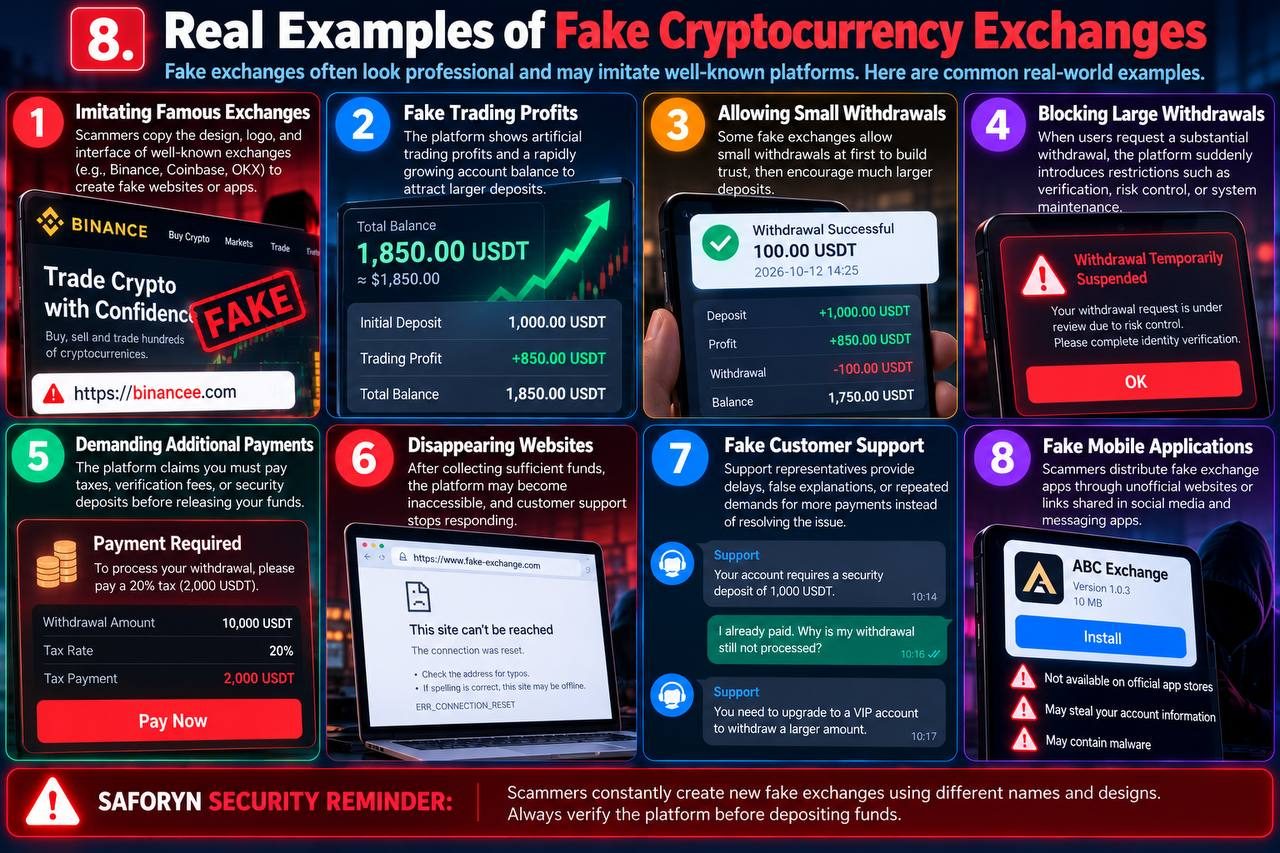
Fake exchange scams are particularly dangerous because they exploit users' trust in familiar trading technology.
Modern fraudulent platforms may imitate legitimate exchanges with professional interfaces, live market data, trading histories, and customer support systems.
Victims may believe they are trading real cryptocurrency when they are only interacting with fabricated account information.
The scam can also continue long after the initial deposit.
Each additional payment request creates another opportunity for the attacker to collect funds.
Some victims borrow money or use their remaining savings because they believe one final payment will unlock their balance.
The most important lesson is that displayed profits are not the same as withdrawable funds.
If a platform cannot independently demonstrate legitimacy and repeatedly demands more deposits before releasing your money, the risk of fraud is substantial.
9. SAFORYN Security Reminder
Verify Before You Deposit. Never Pay to Unlock Fake Profits.
A legitimate-looking trading dashboard does not prove that your cryptocurrency is safe.
Always research unfamiliar exchanges, verify official websites, and question unexpected withdrawal fees.
Remember: If you must keep depositing money to withdraw your existing funds, stop and investigate before paying anything more.
10. Share This Article. Help Prevent the Next Victim.
One Share Could Save Someone's Crypto.
Fake cryptocurrency exchanges can look professional, display convincing profits, and imitate trusted financial platforms.
Many victims only discover the danger when they attempt to withdraw their funds.
To help prevent the next victim, SAFORYN encourages you to share this article with your friends, family, and cryptocurrency communities. Your one share could help someone recognize a fake exchange before losing their savings.