
SAFORYNACADEMY
Emergency Guide: What to Do After a Cryptocurrency Scam
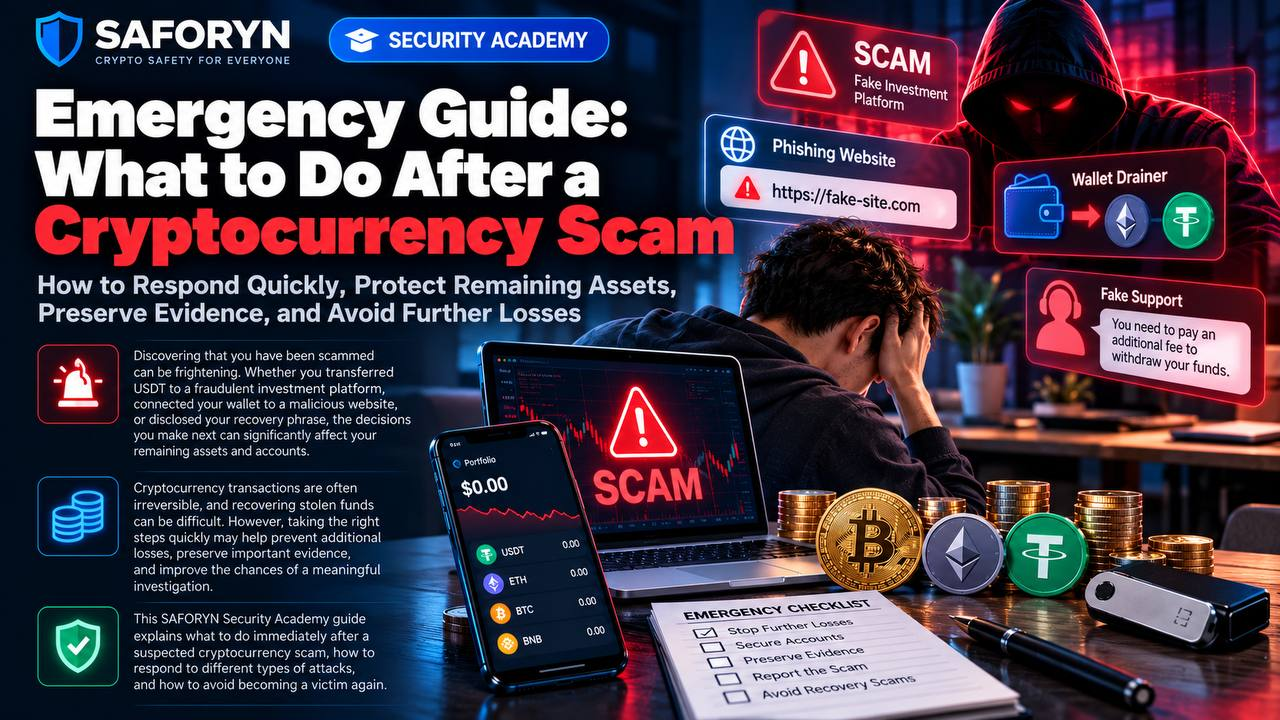
How to Respond Quickly, Protect Remaining Assets, Preserve Evidence, and Avoid Further Losses
Discovering that you have been scammed can be frightening. Whether you transferred USDT to a fraudulent investment platform, connected your wallet to a malicious website, or disclosed your recovery phrase, the decisions you make next can significantly affect your remaining assets and accounts.
Cryptocurrency transactions are often irreversible, and recovering stolen funds can be difficult. However, taking the right steps quickly may help prevent additional losses, preserve important evidence, and improve the chances of a meaningful investigation.
This SAFORYN Security Academy guide explains what to do immediately after a suspected cryptocurrency scam, how to respond to different types of attacks, and how to avoid becoming a victim again.
1. The First 10 Minutes: Stop Further Losses
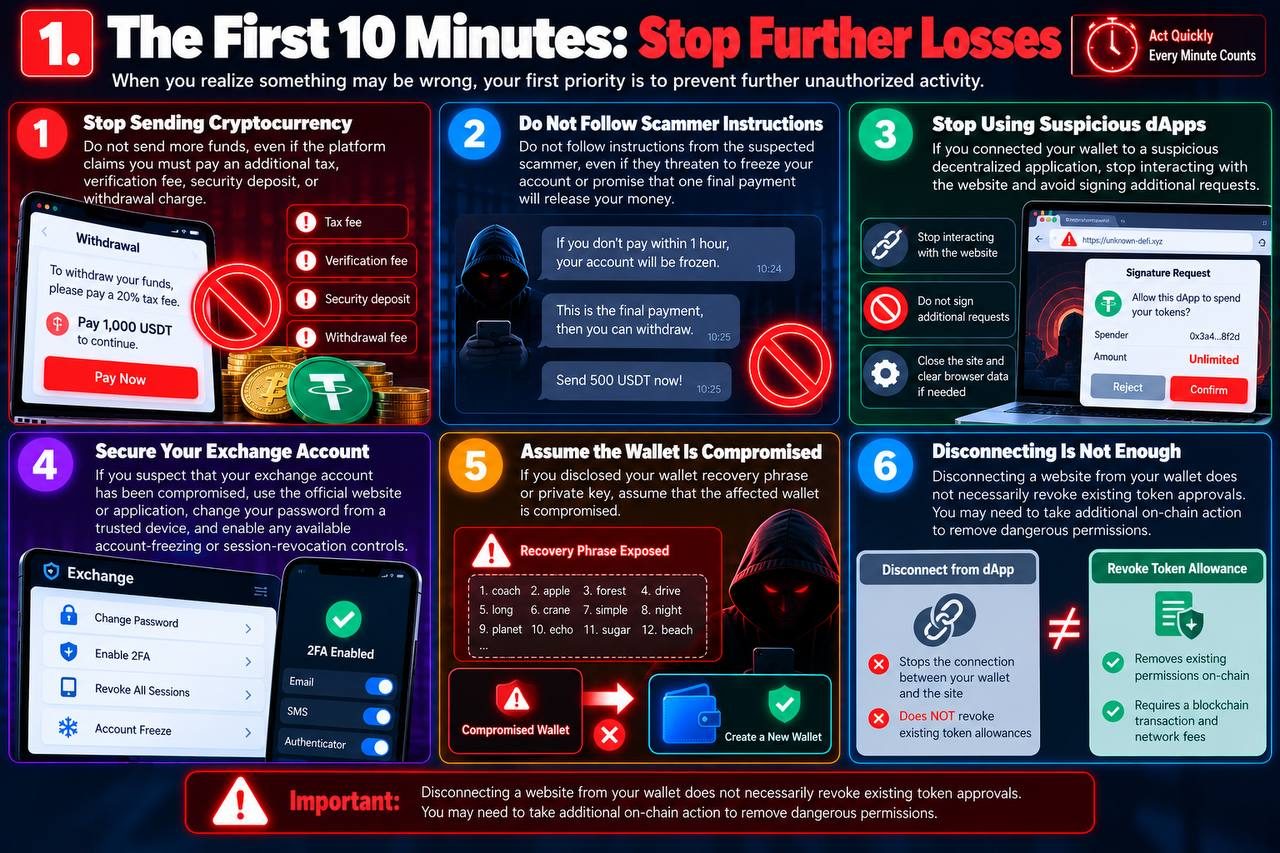
When you realize something may be wrong, your first priority is to prevent further unauthorized activity.
Stop sending cryptocurrency immediately. If a suspicious platform claims you must pay an additional tax, verification fee, security deposit, or withdrawal charge, do not send more funds.
Do not follow instructions from the suspected scammer, even if they threaten to freeze your account or promise that one final payment will release your money.
If you connected your wallet to a suspicious decentralized application, stop interacting with the website and avoid signing additional requests.
If you suspect that your exchange account has been compromised, access the exchange through its independently verified official website or application. Change your password from a trusted device and use any available account-freezing or session-revocation controls.
If you disclosed your wallet recovery phrase or private key, assume that the affected wallet is compromised.
Important: Disconnecting a website from your wallet does not necessarily revoke existing token approvals. You may need to take additional on-chain action to remove dangerous permissions.
2. Identify What Type of Scam Occurred
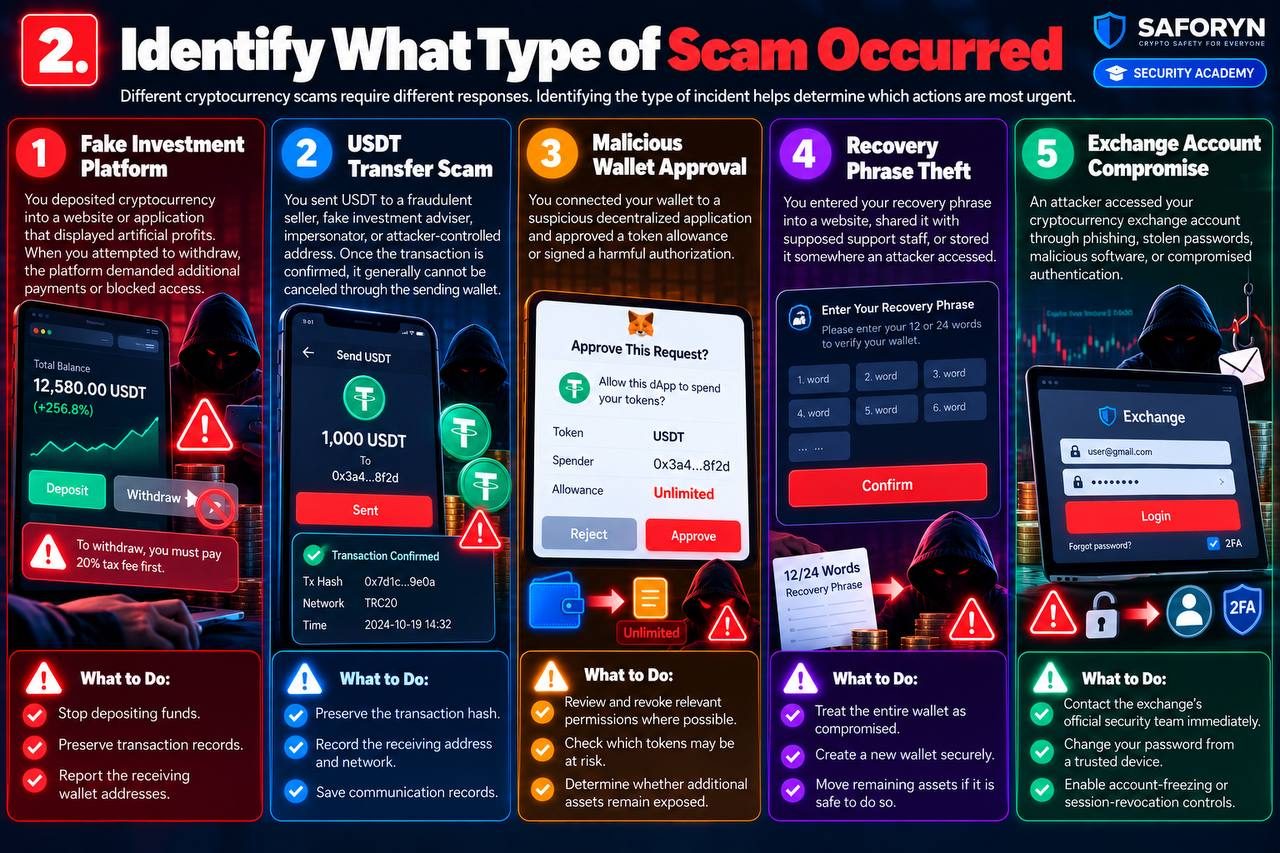
Different cryptocurrency scams require different responses. Identifying the type of incident helps determine which actions are most urgent.
Fake Investment Platform
You deposited cryptocurrency into a website or application that displayed artificial profits. When you attempted to withdraw, the platform demanded additional payments or blocked access.
In this situation, stop depositing funds, preserve transaction records, and report the receiving wallet addresses.
USDT Transfer Scam
You sent USDT to a fraudulent seller, fake investment adviser, impersonator, or attacker-controlled address.
Once the transaction is confirmed, it generally cannot be canceled through the sending wallet.
Preserve the transaction hash, receiving address, network, and communication records.
Malicious Wallet Approval
You connected your wallet to a suspicious decentralized application and approved a token allowance or signed a harmful authorization.
Review and revoke relevant permissions where possible, and determine whether additional assets remain exposed.
Recovery Phrase Theft
You entered your recovery phrase into a website, shared it with supposed support staff, or stored it somewhere an attacker accessed.
Treat the entire wallet as compromised. Create a new wallet securely and move remaining assets if it is safe to do so.
Exchange Account Compromise
An attacker accessed your cryptocurrency exchange account through phishing, stolen passwords, malicious software, or compromised authentication.
Contact the exchange's official security team immediately and request available account protections.
3. What to Do If You Sent USDT to a Scammer
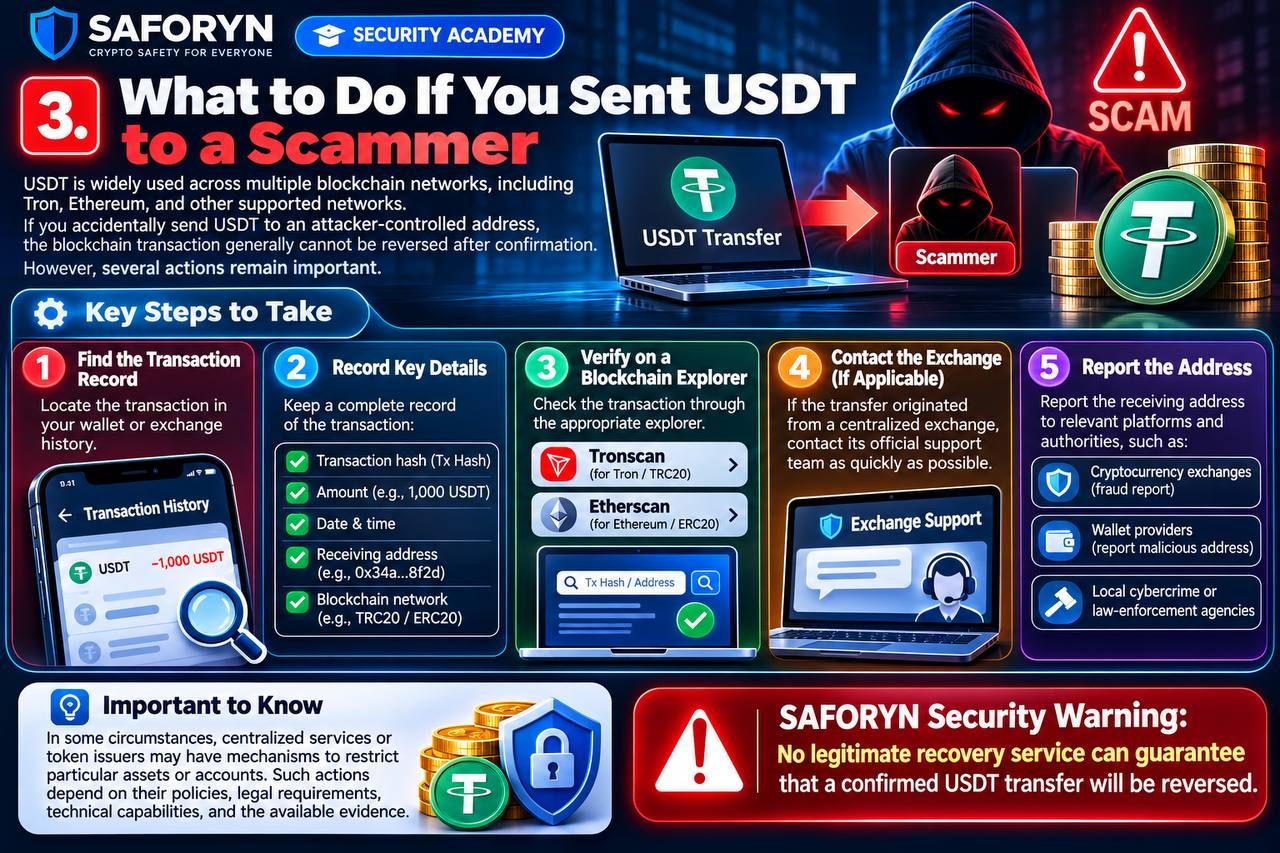
USDT is widely used across multiple blockchain networks, including Tron, Ethereum, and other supported networks.
If you accidentally send USDT to an attacker-controlled address, the blockchain transaction generally cannot be reversed after confirmation.
However, several actions remain important.
First, locate the transaction in your wallet or exchange history.
Record the transaction hash, amount, date, receiving address, and blockchain network.
Next, verify the transaction through the appropriate blockchain explorer, such as Tronscan for Tron or Etherscan for Ethereum.
If the transfer originated from a centralized exchange, contact its official support team as quickly as possible. Provide the transaction details and explain that you suspect fraud.
You can also report the receiving address to relevant platforms and authorities.
In some circumstances, centralized services or token issuers may have mechanisms to restrict particular assets or accounts. Such actions depend on their policies, legal requirements, technical capabilities, and the available evidence.
SAFORYN Security Warning: No legitimate recovery service can guarantee that a confirmed USDT transfer will be reversed.
4. What to Do If Your Wallet Has Been Compromised
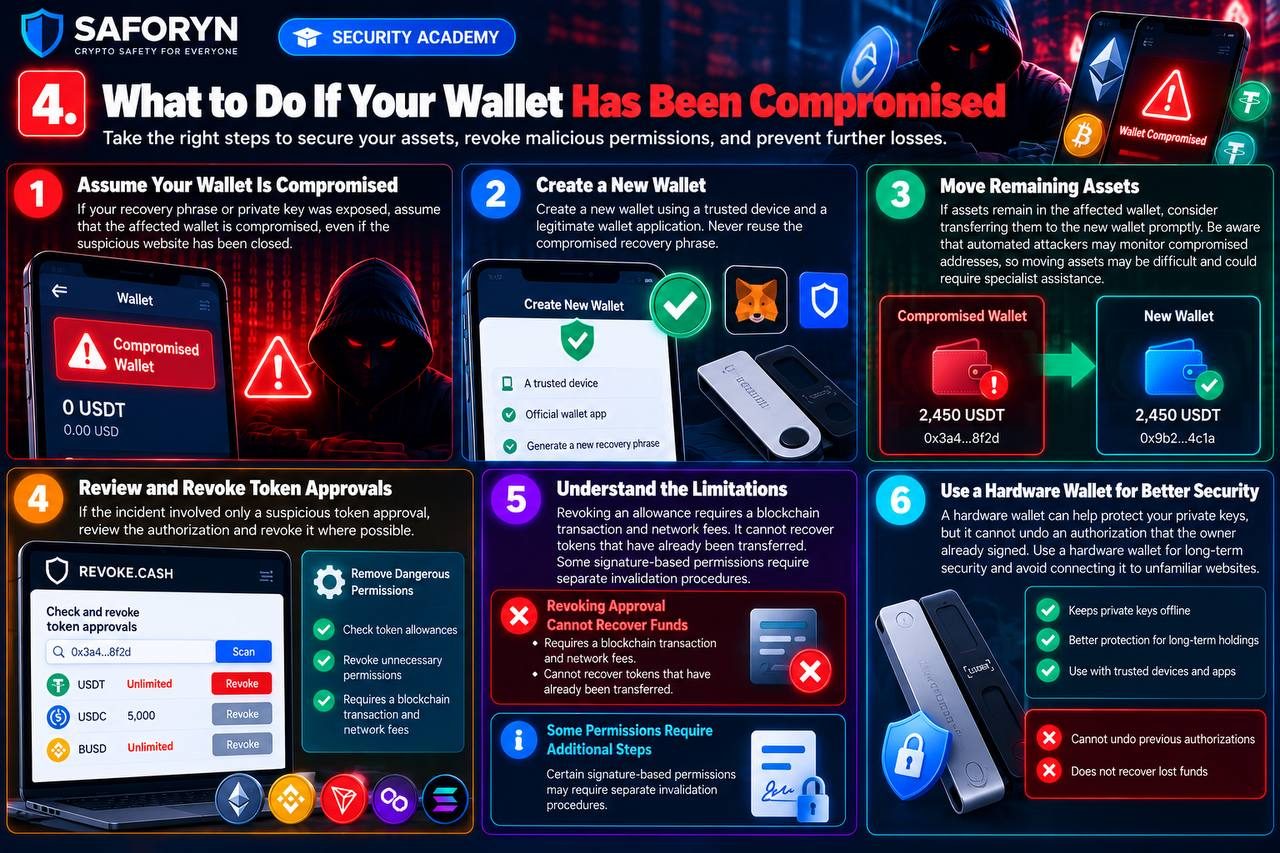
A compromised wallet may remain vulnerable even after the original suspicious website has been closed.
If your recovery phrase or private key was exposed, create a new wallet using a trusted device and a legitimate wallet application.
Never reuse the compromised recovery phrase.
If assets remain in the affected wallet, consider transferring them to the new wallet promptly. Be aware that automated attackers may monitor compromised addresses, so moving assets may be difficult and could require specialist assistance.
If the incident involved only a suspicious token approval, review the authorization before deciding whether a full wallet migration is necessary.
For compatible networks, tools such as Revoke.cash can help users inspect and revoke token allowances.
Revoking an allowance requires a blockchain transaction and network fees. It cannot recover tokens that have already been transferred.
Some signature-based permissions require separate invalidation procedures.
A hardware wallet can help protect private keys, but it cannot undo an authorization that the owner already signed.
5. Preserve Evidence Before It Disappears
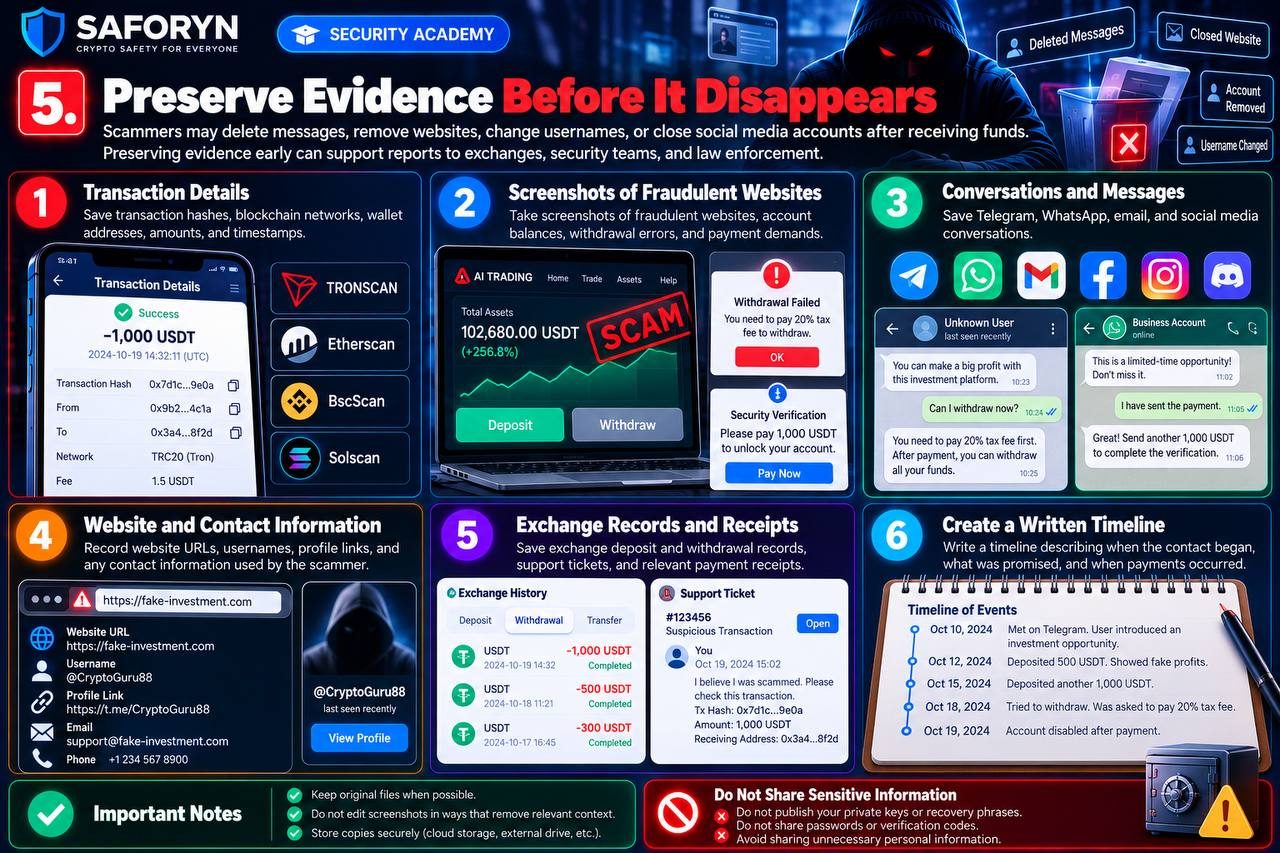
Scammers may delete messages, remove websites, change usernames, or close social media accounts after receiving funds.
Preserving evidence early can support reports to exchanges, security teams, and law enforcement.
Save the following information:
Transaction hashes, blockchain networks, wallet addresses, amounts, and timestamps.
Screenshots of fraudulent websites, account balances, withdrawal errors, and payment demands.
Telegram, WhatsApp, email, and social media conversations.
Website URLs, usernames, profile links, and any contact information used by the scammer.
Exchange deposit and withdrawal records, support tickets, and relevant payment receipts.
A written timeline describing when the contact began, what was promised, and when payments occurred.
Keep original files when possible. Do not edit screenshots in ways that remove relevant context.
Store copies securely and avoid publishing private keys, recovery phrases, passwords, or unnecessary personal information.
6. How to Report a Cryptocurrency Scam
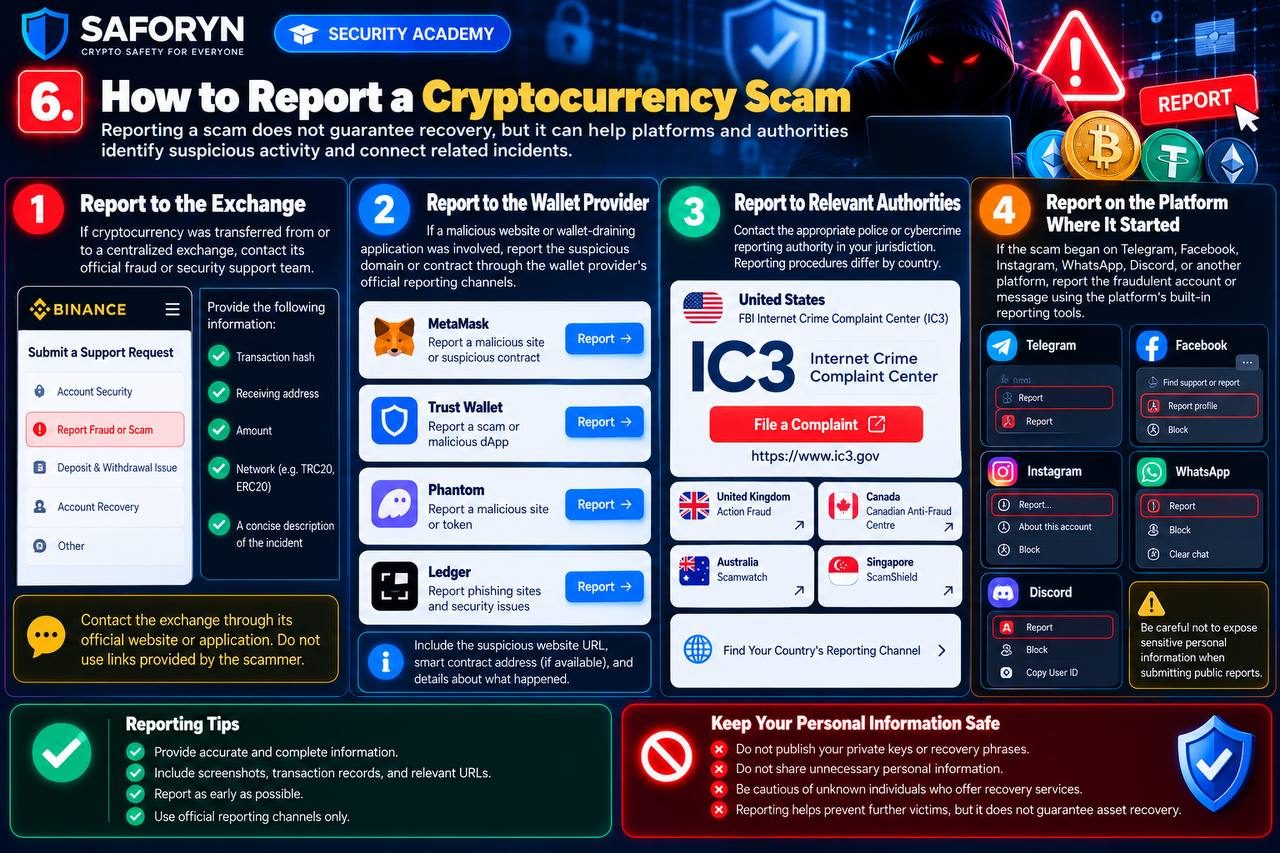
Reporting a scam does not guarantee recovery, but it can help platforms and authorities identify suspicious activity and connect related incidents.
Report to the Exchange
If cryptocurrency was transferred from or to a centralized exchange, contact its official fraud or security support team.
Provide the transaction hash, receiving address, amount, network, and a concise description of the incident.
Report to the Wallet Provider
If a malicious website or wallet-draining application was involved, report the suspicious domain or contract through the wallet provider's official reporting channels.
Report to Relevant Authorities
Contact the appropriate police or cybercrime reporting authority in your jurisdiction.
For example, in the United States, suspected internet-enabled cryptocurrency fraud can be reported to the FBI Internet Crime Complaint Center (IC3).
Reporting procedures differ by country.
Report the Scam on the Platform Where It Started
If the scam began on Telegram, Facebook, Instagram, WhatsApp, Discord, or another platform, report the fraudulent account or message using the platform's built-in reporting tools.
Be careful not to expose sensitive personal information when submitting public reports.
7. Beware of Cryptocurrency Recovery Scams
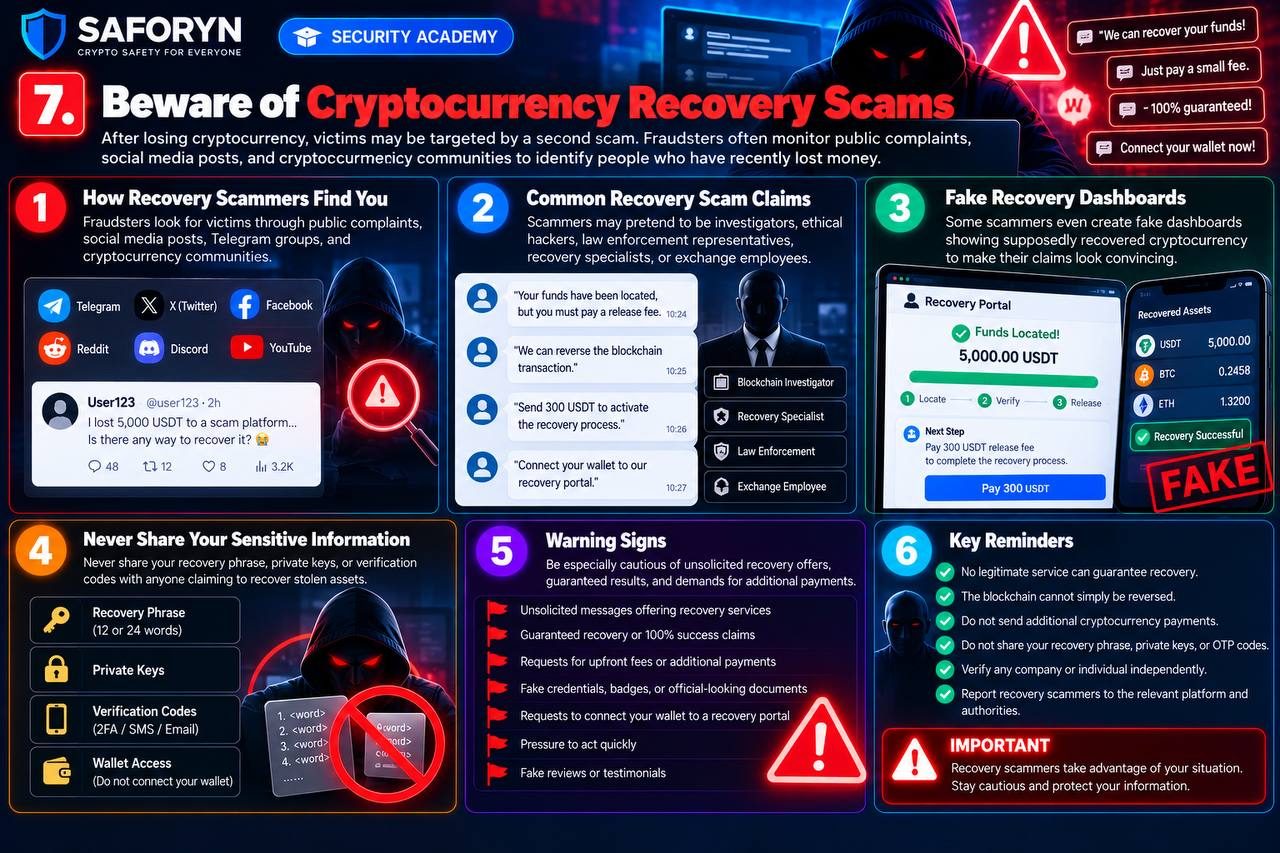
After losing cryptocurrency, victims may be targeted by a second scam.
Fraudsters often monitor public complaints, social media posts, and cryptocurrency communities to identify people who have recently lost money.
They may claim to be blockchain investigators, ethical hackers, law enforcement representatives, recovery specialists, or exchange employees.
These individuals might promise to recover stolen assets in exchange for an upfront fee.
Common claims include:
"Your funds have been located, but you must pay a release fee."
"We can reverse the blockchain transaction."
"Send 300 USDT to activate the recovery process."
"Connect your wallet to our recovery portal."
Some scammers even create fake dashboards showing supposedly recovered cryptocurrency.
Never share your recovery phrase, private keys, or verification codes with anyone claiming to recover stolen assets.
Be especially cautious of unsolicited recovery offers, guaranteed results, and demands for additional cryptocurrency payments.
8. Can Stolen Cryptocurrency Be Recovered?
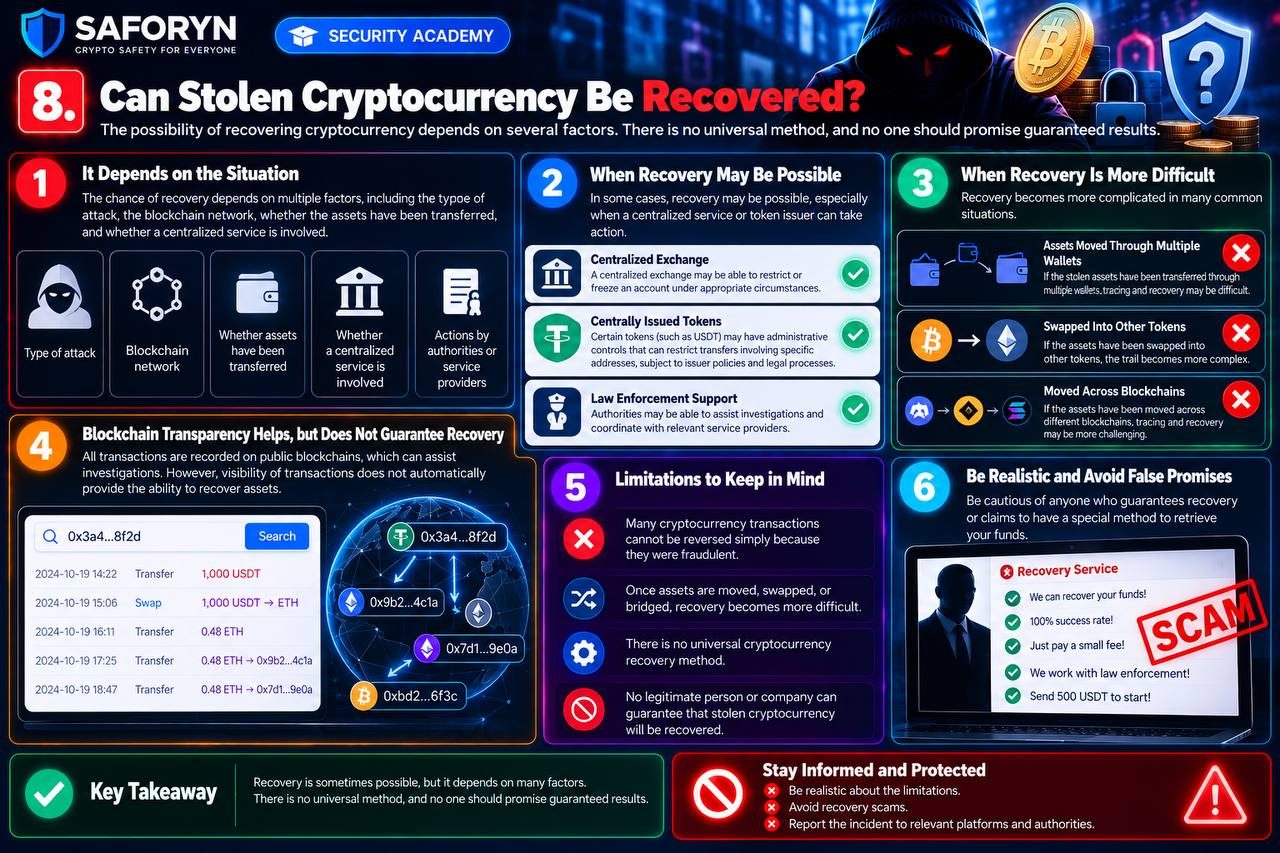
The possibility of recovering cryptocurrency depends on several factors.
These include the type of attack, the blockchain network, whether the stolen assets have been transferred, whether a centralized service is involved, and whether authorities or relevant service providers can take action.
For example, a centralized exchange may be able to restrict an account under appropriate circumstances.
Certain centrally issued tokens may have administrative controls that can restrict transfers involving specific addresses, subject to issuer policies and applicable legal processes.
However, many cryptocurrency transactions cannot be reversed simply because they were fraudulent.
If assets have been transferred through multiple wallets, swapped into other tokens, or moved across blockchains, tracing and recovery may become more complicated.
Blockchain transparency can assist investigations, but visibility of transactions does not automatically provide the ability to recover assets.
There is no universal cryptocurrency recovery method, and no one should promise guaranteed results.
9. How to Protect Yourself from Being Scammed Again
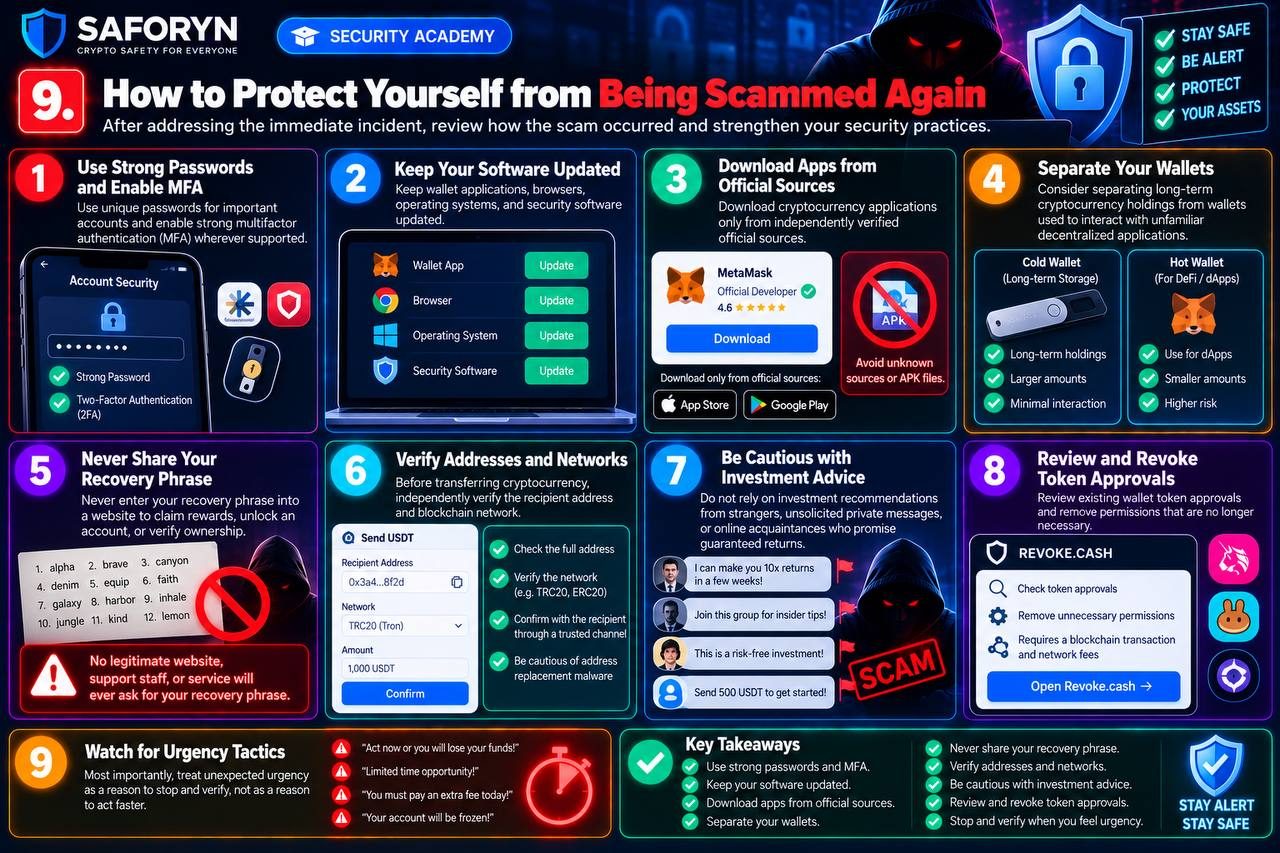
After addressing the immediate incident, review how the scam occurred and strengthen your security practices.
Use unique passwords for important accounts and enable strong multifactor authentication wherever supported.
Keep wallet applications, browsers, operating systems, and security software updated.
Download cryptocurrency applications only from independently verified official sources.
Consider separating long-term cryptocurrency holdings from wallets used to interact with unfamiliar decentralized applications.
Never enter your recovery phrase into a website to claim rewards, unlock an account, or verify ownership.
Before transferring cryptocurrency, independently verify the recipient address and blockchain network.
Do not rely on investment recommendations from strangers, unsolicited private messages, or online acquaintances who promise guaranteed returns.
Review existing wallet token approvals and remove permissions that are no longer necessary.
Most importantly, treat unexpected urgency as a reason to stop and verify, not as a reason to act faster.
10. SAFORYN Emergency Security Checklist
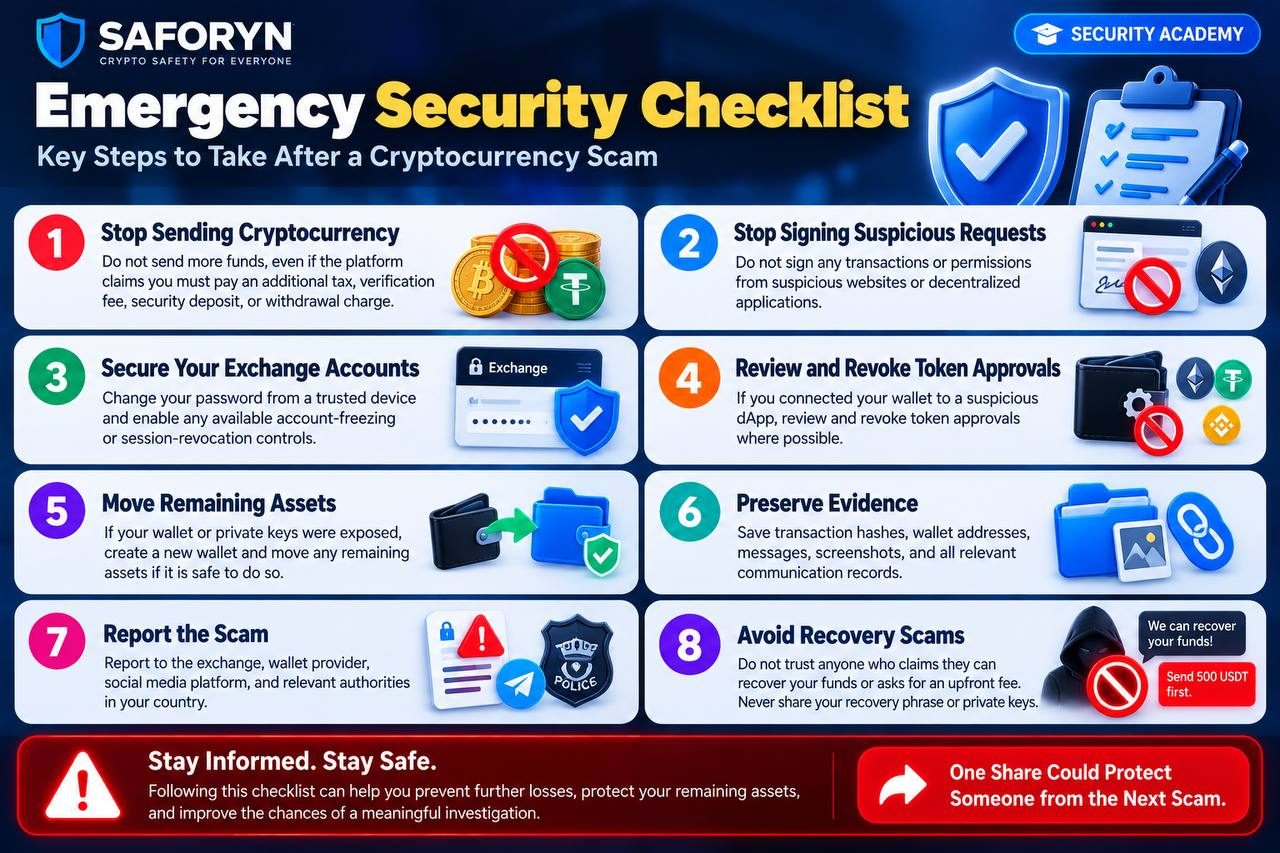
- Stop sending cryptocurrency. Do not send more funds, even if the platform claims you must pay an additional tax, verification fee, security deposit, or withdrawal charge.
- Stop signing suspicious requests. Do not sign any transactions or permissions from suspicious websites or decentralized applications.
- Secure your exchange accounts. Change your password from a trusted device and enable any available account-freezing or session-revocation controls.
- Review and revoke token approvals. If you connected your wallet to a suspicious dApp, review and revoke relevant approvals where possible.
- Move remaining assets. If your wallet or private keys were exposed, create a new wallet and move any remaining assets if it is safe to do so.
- Preserve evidence. Save transaction hashes, wallet addresses, messages, screenshots, and all relevant communication records.
- Report the scam. Report to the exchange, wallet provider, social media platform, and relevant authorities in your country.
- Avoid recovery scams. Do not trust anyone who claims they can recover your funds or asks for an upfront fee. Never share your recovery phrase or private keys.
11. Share This Guide — Help Prevent the Next Victim
One Share Could Protect Someone from Losing Their Crypto.
Cryptocurrency scams can affect anyone, regardless of experience.
Many victims lose additional funds because they do not know what to do immediately after discovering fraud.
SAFORYN encourages you to share this emergency guide with your friends, family, and cryptocurrency communities. Your one share could help someone stop a scam, protect their remaining assets, and avoid becoming the next victim.